Farm Security Cameras in Australia: The Ultimate Guide

With rural Police often some distance away, farms are easy targets for crime. They are too large to defend effectively and have high-value items on their property. Whether it’s theft of farm equipment, livestock, produce or even just trespassing, farm security cameras can help protect your assets.

However, due to the vastness of some farms and limited connectivity, they require customised solutions. this article covers the most common targets and what farm security cameras to use to protect them.

1

Where Do You Need Protection on the Farm

Every farm is different, but there are a few key spots that thieves often target. Thinking about these areas first will help you and a local installer design the right system for your property.


At the Gate

Your gate is the first line of defence. A camera here helps you see who’s entering and leaving, and can be set up to capture number plates. With solar or wireless options, even gates far from the house can be monitored.

A gate camera does more than catch trespassers. On many rural properties it becomes the closest thing to a property movement log. Contractors, delivery drivers, livestock transport, machinery movements, and unknown vehicles all pass through the gate. If stock, fuel, tools, chemicals, or machinery go missing, knowing who entered the property and when is often the starting point for any police report or insurance claim. A camera that captures a clear image of the vehicle and number plate at the gate is one of the most practically useful cameras on any farm.


Around Machinery and Fuel Tanks

Tractors, utes, tools, and diesel tanks are some of the most common targets for farm theft. Cameras here should provide detail, even at night, so you can identify faces or vehicles if there’s an incident.

A camera near the fuel tank is useful, but a camera alone may not be enough to prove fuel theft. A more complete setup pairs a camera on the access route and a second camera covering the bowser area with a tank level sensor that records when the fuel level drops. If a vehicle arrives at 2:06am, the tank level drops at 2:13am, and the camera captures a number plate or vehicle description, those three pieces of information together create a chain of evidence. One without the others is much harder to act on.


In the Paddocks

Paddocks cover vast distances, making them impossible to physically monitor regularly. Cameras here are often used to check on livestock without long drives, monitor water troughs and tanks, and detect unusual activity around boundary fences. Solar-powered or 4G trail cameras are the most practical option in remote paddock locations.


Near the Farmhouse and Sheds

The home, workshop, and storage sheds are high-value areas. Wired systems are often used here since power and internet are usually available, giving you reliable coverage and continuous recording.

2

Stories from Australian Farms

While every farm is different, many deal with similar problems. Here are a few examples of how local installers have helped:

  • A farmer in Dubbo was losing diesel at night. After installing a solar-powered gate camera through a local installer, they caught the culprit on video and passed it on to police.
  • A Toowoomba farm had repeated shed break-ins. An installer designed a wired system to cover the machinery shed and fuel tanks. Since then, no more losses.
  • On a cattle property in western Victoria, a farmer wanted to check livestock without long drives. With rugged trail cameras set up in the paddocks, they can now view animals remotely on their phone.

3

Farm Cameras Are Only Useful If They Create Evidence

Most farms are too large to personally supervise, too remote for rapid police response, and too exposed to rely on neighbours noticing something unusual. A security camera system that only records footage, without making that footage usable, is not much more than a recording device.

The better way to think about a farm camera system is as an evidence layer across the property. When something goes wrong, the system should be able to answer:

Who entered the property, and when? Which gate, track, shed, tank, or yard did they access? What vehicle was involved? Is the image clear enough for police to work with? Is there enough detail to support an insurance claim?

A camera that shows a blurry figure near a fuel tank at night answers none of those questions usefully. A camera positioned to capture number plates at the gate, paired with a second camera covering the bowser area, paired with time-stamped records from a tank sensor, answers most of them.

The camera type matters less than whether the system was designed to capture usable evidence at the specific locations where something is likely to happen. That is the question to bring to a licensed installer.

4

Detect, Identify, Prove, Respond

A useful way to assess any farm camera plan is to run each location through four questions.

Detect: Will the system notice that something happened? This might be a gate opening, a motion trigger in a shed, a camera alert on a 4G network, or a tank sensor showing an unexpected level change.

Identify: Will the system capture enough detail to know who or what was involved? A wide-angle camera covering a large open area detects movement but often cannot identify a face, a number plate, or even a vehicle type at distance.

Prove: Will the system produce a timestamped, usable record that can be passed to police, insurers, farm managers, or neighbours? Footage that has already been overwritten, is too dark to read, or cannot be extracted from a failed device does not prove anything.

Respond: Does the system alert someone in time for a response to be useful? A camera that stores footage to an SD card in a remote paddock detects and identifies but does not help anyone respond until the card is physically checked.

Many farm camera systems fail at identify or prove. They detect that something happened, but the footage does not support any action. Understanding which of these four steps is the weakest in a current or proposed setup is often more useful than asking which camera to buy.

5

What are the Most Common Farm Crimes?

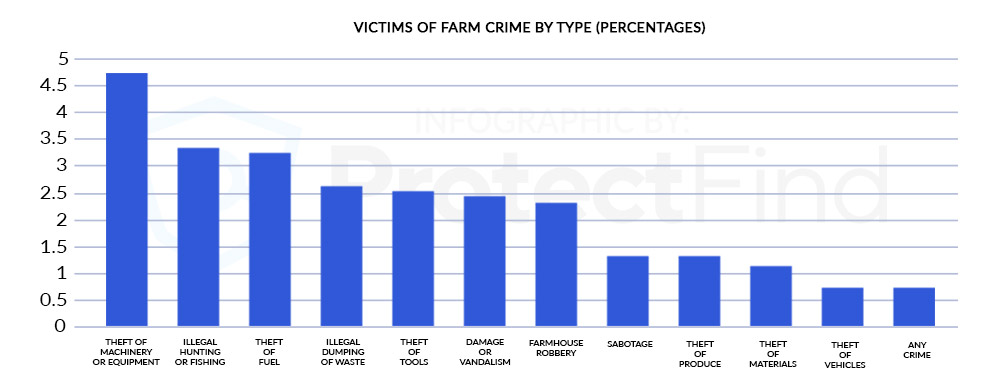
The most comprehensive national study of farm crime in Australia is the Australian Institute of Criminology's National Farm Crime Survey from 2002-03, which found that an estimated 17 per cent of farmers had experienced crime related to their farming activities. The AIC estimated the cost to the Australian economy at $70 million annually, with an average cost per farm of $5,701. A more recent national survey has not been conducted.

The chart below shows the breakdown of farm crime types from that survey.

Types of Crime on Farms

More recent state-level reporting suggests the problem has grown significantly since then. According to Stock & Land in December 2025, farm-related crime in South Australia was at its highest point in five years. Theft from farms reached 1,621 recorded offences in the 12 months to September 2025, up 5 per cent on the previous year. Motor vehicle theft from farms, including tractors and utes, rose 11 per cent to 428 recorded cases. Farm property damage offences were significantly higher than in 2022 and 2023

These are some of the key areas to cover with farm security camera systems:

  • Fuel tanks
  • Water supplies
  • Various internal fence lines and boundary fences
  • Farm gate
  • Holding pens

6

Types of Farm Security Cameras 

The type of cameras you choose for your farm security system depends on how much money you want to spend and how reliable would you like it to be.

Consumer-Grade Wireless Farm Security Cameras

These wireless farm security cameras are the lowest cost entry into some basic farm monitoring, but they have many limitations too.

They usually have a wide field of view, allowing you to see more of your farm but less far. This means that they will need to be within 6 metres or so to identify someone, which is not much on a farm.

They are usually triggered by a PIR sensor that detects humans or animals' heat. The problem with this is it has a limited range, usually only 10 metres.
There is also a question of the reliability of plastic

consumer-grade cameras in the dust and heat found on an Australian farm.


Consumer Grade Wireless Farm Security Camera

Trail Cameras

Trail Cameras are built to work as rural security cameras in rugged environments. Some will only record to an SD card, while others use 4G connectivity to send alerts to smartphones.

Many are sold in camouflage colouring if you don't want them to be noticed, and some have no or "low glow" infrared, so you can't see the camera's red infrared lights at night, making it truly stealth.
These can be mounted on houses, poles or even trees, many coming with straps to mount it to a tree.

Some operate on batteries only which you need to replace now and then, and some can be supplemented with a solar panel to keep it charged.
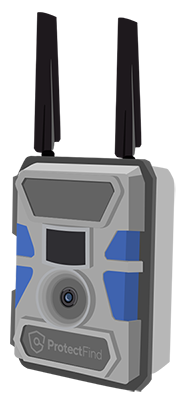

Trail Security Camera

Prosumer-Grade Wired Farm Cameras

Wired security cameras provide the best level of reliability if you have wired internet available (like in the house).

"Prosumer" means Professional Consumer, above consumer-grade but below the expensive professional-grade cameras you might find in a bank or casino.

Wired farm cameras provide a great bang-for-buck, but there can be challenges with getting them connected, as mentioned in the next topic.

It is best to use either a Turret camera or a Bullet camera, as

Dome security cameras can get too much dust on their dome in rural settings.
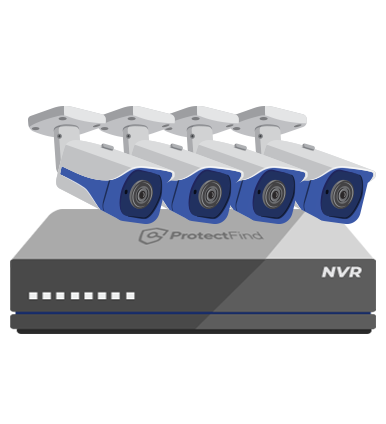
Prosumer-Grade Wired Farm Cameras

Pole Mounted Solar Farm Security Cameras

These security cameras mounted on a pole are often used as construction site cameras. These are a good choice when getting power and internet to a location (like a farm gate) is difficult.
They can be rented and custom-built to your requirements to include things like strobes, spotlights, and 4G modems.

They usually contain a battery and are self-sufficient with their solar panels.
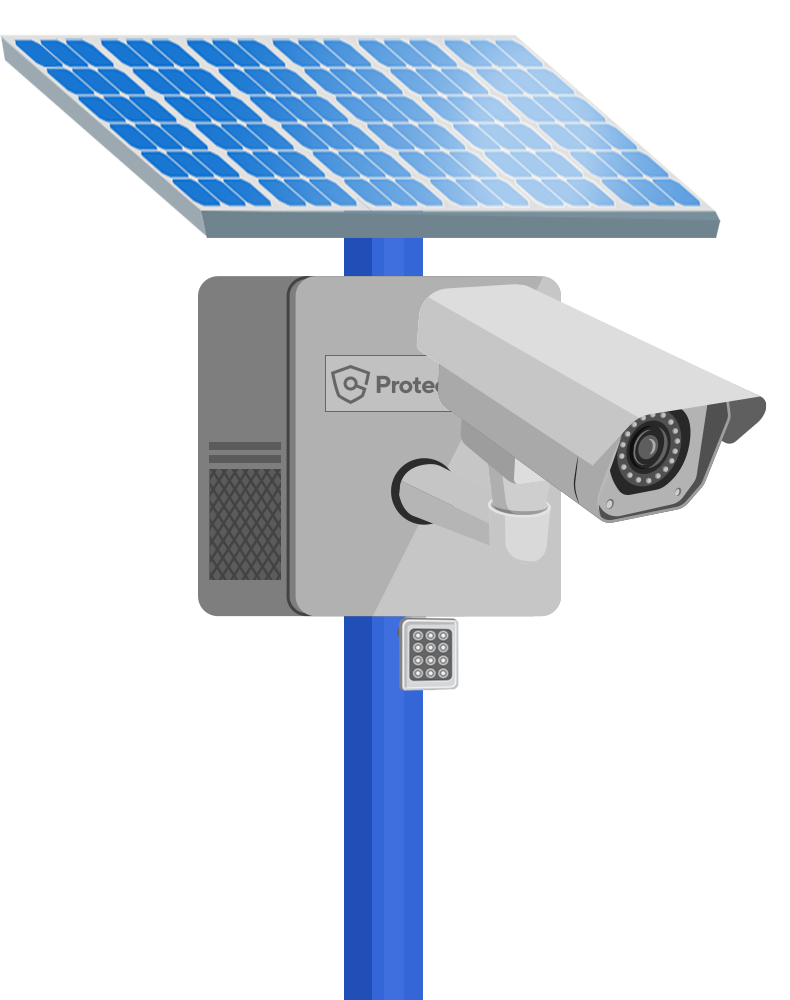
Pole Mounted Solar Farm Security Camera

7

Choose Cameras Based on the Event, Not Just the Camera Type

Most articles about farm cameras lead with hardware: trail cameras for paddocks, wired cameras for sheds, 4G cameras for remote gates. That is useful framing, but a better starting point is what event the camera needs to detect, identify, or prove.

Unknown vehicle at the gate: gate sensor, number plate camera positioned to capture the front of the vehicle as it enters, and an overview camera for context.

Fuel level drops overnight: tank level sensor, camera on the access route to the tank, second camera covering the bowser area or filling point.

Shed break-in: camera at entry points capturing faces at usable range, camera inside or opposite the shed doorway, local recording that continues even if internet drops.

Livestock missing or loading ramp used without authorisation: stockyard camera covering the loading ramp and gate, truck access point camera.

Trespass near animal areas: perimeter camera, restricted area camera, motion-triggered alert.

Water pump off or trough running low: water level or flow sensor combined with a camera confirming whether the cause was mechanical or human.

Remote paddock activity: trail camera, solar 4G camera, or point-to-point wireless depending on coverage. The camera type is the last decision, not the first.

Thinking through the event before choosing the hardware leads to fewer cameras installed in the wrong place and more cameras covering the spots that matter.

8

Farm Cameras Can Also Support Biosecurity

Most farm security camera articles focus on theft and trespass. On some properties, unauthorised entry creates a second problem: biosecurity risk.

Farms running livestock, poultry, pork, dairy, or feedlot operations often have strict visitor controls and signage restricting entry to certain areas. An unauthorised person who enters an animal housing area, crosses into a restricted yard, or moves between sheds without authorisation may create a disease risk regardless of whether they take anything.

A camera system that records who entered, when they entered, which gates they passed through, and whether they approached restricted animal areas creates a record that can matter for disease tracing, insurance, compliance, and neighbour or contractor disputes as well as theft investigation.

The setup does not need to be separate from the theft-deterrence system. A well-placed gate camera and perimeter camera serves both purposes. The point is that when designing camera coverage, biosecurity access points are worth including alongside the usual targets of fuel, machinery, and shed entries.

9

AI Farm Cameras Can Help, But Ask Hard Questions

An increasing number of farm camera systems are marketed on AI features: person detection, vehicle detection, animal detection, number plate recognition, smart alerts, and remote monitoring. These features can genuinely reduce false alerts and improve notification quality on a farm, where the environment produces a lot of movement that is not a security event.

Rural environments are harder on AI detection than suburban ones. Moving trees, livestock, wildlife, machinery, insects on the lens, dust, rain, and headlight wash all create conditions that trigger less sophisticated systems repeatedly. A system that sends fifty alerts a night quickly becomes one the farmer stops checking.

Before accepting an AI camera specification, the following questions are worth asking:

  • Does the camera detect people, vehicles, animals, or any motion? What can it tell apart?
  • Can detection zones be shaped to cover a gate, tank, shed entry, or driveway specifically rather than a wide open area?
  • Can alerts be set to after-hours only, or will the system trigger during normal working hours too?
  • Does it continue recording if the 4G connection drops?
  • Can it capture number plates at night, or will headlights and infrared wash out the image?
  • How does it handle dust, heavy rain, insects on the lens, moving livestock, and reflective surfaces?
  • Are alerts sent to the farmer directly, a monitoring company, or both? What happens after an alert is sent?

AI camera marketing tends to show ideal conditions. A practical installer will tell you how the system performs in the conditions at a specific farm.

10

Getting Farm Security Camera Systems Connected

The problem with farm security cameras is that you need to solve two problems: power and connectivity over large distances.

Due to the large distances involved with farms, most off-the-shelf solutions available at most electronics stores would not work. You would generally need a custom farm security system that is specific to your situation.

Wired – Short Distances (< 100m)

If your buildings are close enough, digging a trench and laying down cables is a reliable way to set up farm security cameras. However, this process can be costly if your locations are far apart.

Wired cameras are more challenging to set up first but always result in a more reliable install. They are not prone to wireless interference, signal strength problems or Wi-Fi hacking.

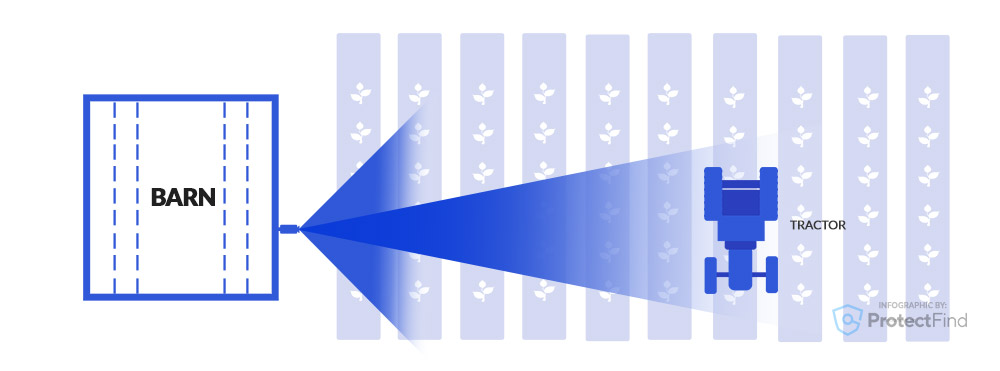
A common setup has a switch/router in the house and a network cable running through a buried conduit into the bar in the example below. This setup assumes there is power in the barn.
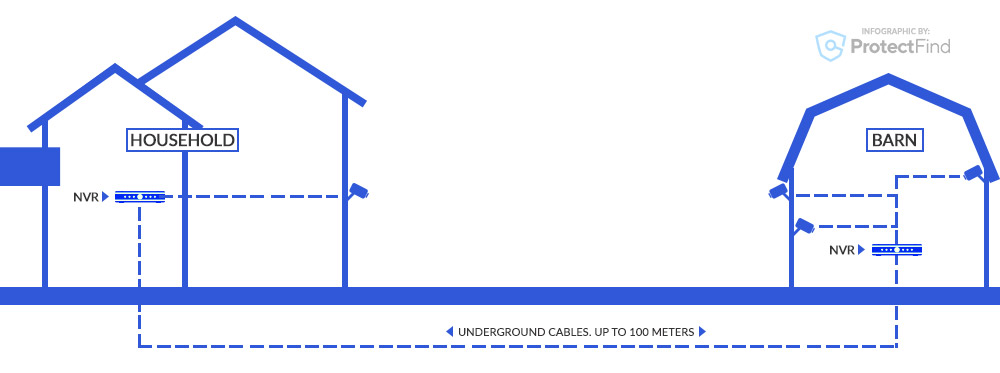
Wired Farm Security Cameras

Advantages:

  • Most reliable option
  • Footage can be constantly monitored on a screen

Disadvantages:

  • Limited to around 100m distance
  • Costs more to trench a cable

Point-to-Point Wireless – Medium Distances (500m – 3KM)

Most consumer wireless routers aren’t powerful enough to send a Wi-Fi signal far from the house, so a traditional wireless security camera may not work in the position you want it, like out in a barn. A Point-to-Point wireless bridge can connect two networks over many kilometres depending on the line of sight.

A point-to-point wireless bridge involves having two-directional antennas with a direct line of sight to each other. This can sometimes be placed on the side of a building, but putting them high on masts to get the signal over ground obstacles is also common.

In one structure, you might have a recording device (NVR). In another structure, such as a barn, you might have farm security cameras. The point-to-point wireless antennas connect these two networks. If running a buried network cable is unviable due to distance or obstructions in the ground, a point-to-point wireless bridge might be the next best option for large properties in terms of reliability.
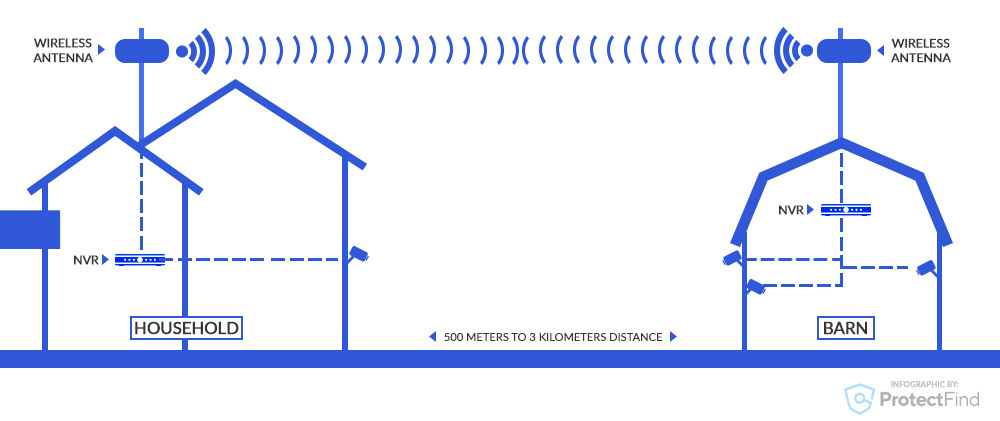
Wireless Point-to-Point Farm Security Cameras

Advantages:

  • Reliable
  • Works for distances under 3km

Disadvantages:

  • Needs line-of-sight
  • Expensive

Starlink — An Option for Remote Properties

Starlink satellite internet has become a practical connectivity option for many Australian farms, including remote properties where 4G signal is poor or absent. A Starlink connection at the farmhouse or a shed can support wired IP cameras connected via NVR, as well as remote viewing and cloud notifications over satellite.

Latency on Starlink is generally low enough for live camera viewing and motion alert delivery, though it is not a substitute for a wired network where that is available. For farms where neither 4G nor fixed-line internet is viable, Starlink may be the most practical way to get cameras connected at the main homestead.

Very Long Range Farm Surveillance Cameras in Remote Locations

Remote security cameras are also known as game cameras or trail cameras. They are camera hardware built inside a rugged enclosure and usually triggered by motion.

A battery usually powers them, but some also use a solar panel to keep the batteries charged long-term.

If 3G/4G connectivity is NOT available:

The inexpensive units have no internet connectivity and record videos locally into the SD card in the camera. But, this requires regular maintenance to retrieve files from the SD card. You also won’t be alerted to suspicious activity in real-time. So, the recordings are more of an after-the-fact viewing. It won’t stop the crime from happening, but you may have an idea of who did it.
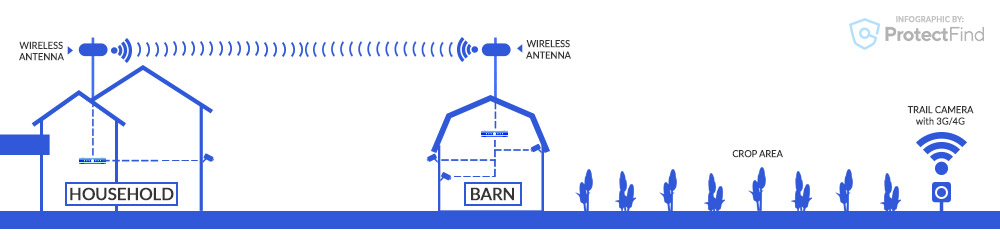
Using 3g / 4g for Security Cameras in Farms

3G/4G Cameras if connectivity is available:

More expensive trail cameras can have 4G connectivity and can be placed any distance away from your home. These trail cameras can be viewed live and send motion alerts and pictures to your phone in real-time. Of course, the location would need a decent 3G/4G signal to use these, which is not always available in remote farm locations.

Trail Security Camera

Example of a 4G-enabled Trail Camera

Remote Farm Security Camera

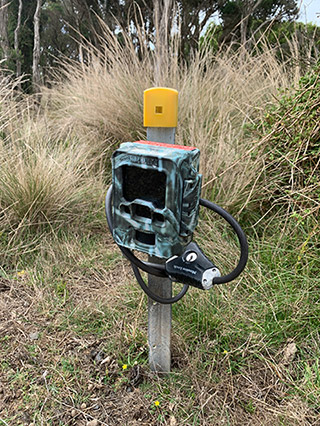
Real-world Trail camera found at the Phillip Island Nature Park.

1111

Choosing the Right Farm Security Cameras

Once you know how the cameras will be connected and powered, some thought needs to be given to the features of the camera.

Lens / Focal Length

Most off-the-shelf camera kits come with a wide field of view, usually around 90 – 110 degrees. These are popular because they allow you to see a wider area. However, the person would need to be within 9 metres to be identified. This is usually fine in a suburban backyard, but not a farm with large distances.

Farm security cameras should be placed to monitor commonly targeted and high-value items like farm machinery. If that object is distant, a farm security camera with a tight field of view should be used to get enough detail of the intruder’s faces orthe number plate of a vehicle.

A camera with a wide field of view can also be used to support it to get more of an overview of the farm. More detail on field of view is covered in this article.

Security camera view distances on farms

Long Range Night Vision

Most consumer-grade security cameras have a relatively short night vision range, usually around 9 metres. Beyond that, it may be total darkness. Prosumer or Professional-grade cameras can see up to 45 metres at night, which can also be supplemented with additional infrared lights.

Build Quality and IP Rating

Standard outdoor cameras are typically rated IP65 or IP66. For farm environments, particularly cameras mounted near dust, machinery, or stock — IP66 or higher is recommended as a minimum. IP66 means the camera is dust-tight and protected against strong water jets. Dome cameras should be avoided in dusty rural settings as their curved lens housing collects dust and degrades night vision image quality. Turret and bullet cameras are better suited to farm conditions.

12

Farm Gate Security Cameras

While you may have cameras set up throughout your farm monitoring machinery or livestock, one of the key areas is to have security cameras at the entrance to your farm. Both power and connectivity need to be present at the front gate, which isn’t always easy. The farmhouse could be just a few metres away from the gate or set 200 metres or more back. This means that trenched wire, point-to-point wireless, or cellular service are all options to help stop farm theft.


Wired Farm Gate Cameras

If the farm gate is close enough, you can run both power and network down a trenched conduit (PVC tubing). This may be a good option if your gate is less than 100 metres away.
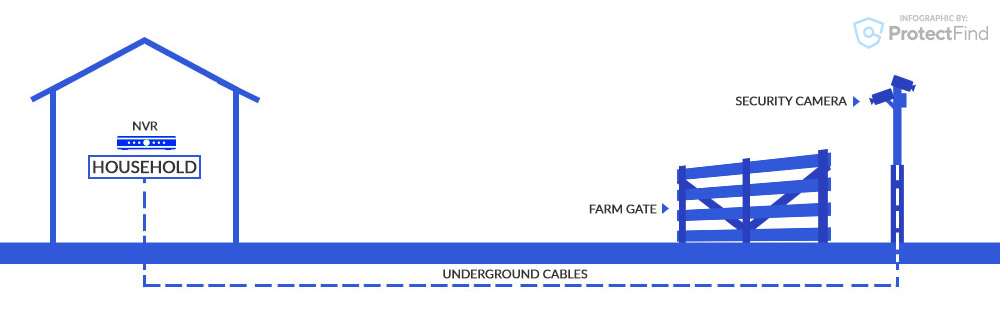
Wired Farm Gate Camera

Point-to-Point Wireless Farm Gate Cameras with Solar

If the gate is too far away, you may need to use point-to-point wireless and a solar panel with a battery as your power source. The only issue with point-to-point wireless is that it needs to have line-of-sight from the gate to the house. There are a number of pre-made options available that have a solar panel, battery/electronics box, security camera, and pole. 
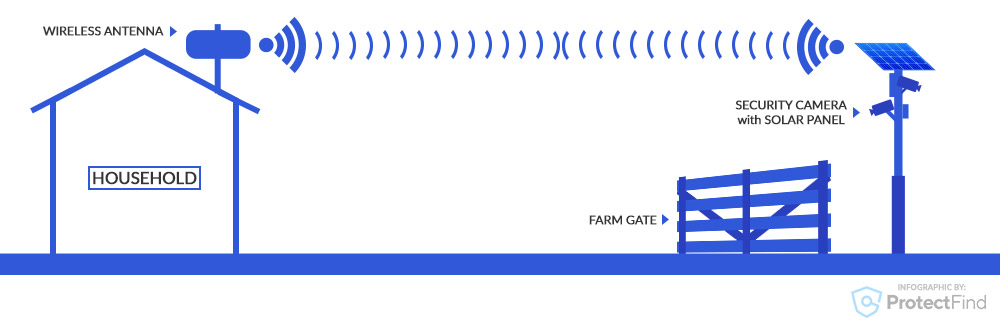
Solar Farm Gate Camera

3G/4G Enabled Farm Gate Cameras with Solar

If point-to-point wireless is not practical such as having no clear line-of-sight to the gate or just too far away, a security camera with a sim card might be an option. However, this does require cellular signal to be available in your area, which is not always the case on remote farms. Many construction site security cameras are suitable to be placed at a farm gate.
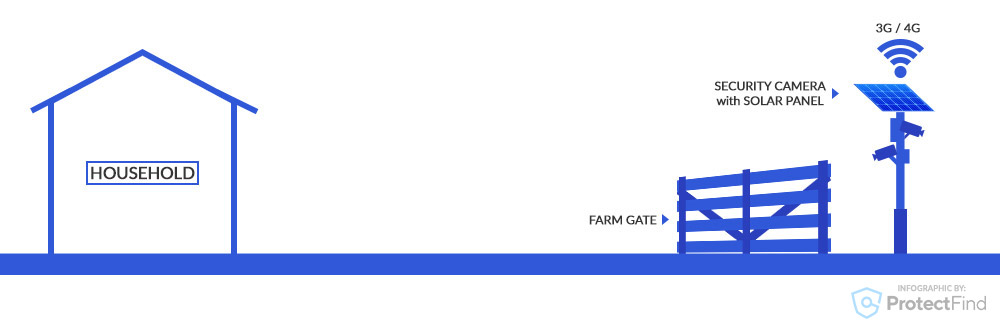
3G/4G Solar Powered Farm Gate Cameras

If the goal is to capture number plates, especially at night, you may need two cameras at the gate. One camera to capture what the vehicle looks like, and number plate camera specifically configured to capture number plates. The reason why two are needed is most cameras will wash out the license plate with infrared at night.

13

Camera Placement Matters More Than Camera Brand

One of the most common reasons farm camera systems fail to produce useful evidence is placement, not hardware. A well-positioned mid-range camera outperforms a poorly positioned premium one.

At the gate: position the camera to capture the front of approaching vehicles at number plate height, not a wide overhead view of the driveway. If vehicles approach from one direction, the camera should face that direction with the sun behind it during daylight hours where possible.

At fuel tanks: one camera covering the access route and one covering the bowser area or fill point, rather than a single camera covering the full tank from a distance.

At sheds: cameras at entry points that capture faces at close range, not cameras mounted high on the corner of a building looking across the full yard.

At stockyards: cameras covering loading ramps, gates, and truck access points, not cameras trying to watch the whole yard from a corner.

In paddocks: focus on choke points such as laneways, water points, gates, and yards rather than trying to cover large open areas where a camera cannot identify a subject at useful distance anyway.

The rule of thumb from installers experienced in rural properties is to decide what you want to see clearly, then work backward to where the camera needs to be and what lens it needs to see it. Coverage area comes after identification quality in the priority order, not before it.

14

Frequently Asked Questions

What are the Best Farm Security Cameras in Australia?

The best farm security camera systems are the ones that fit your unique situation the best. Speak to a security installer to discuss your unique situation and get Prosumer or Professional grade cameras. Many consumer cameras won't last long enough in a harsh farm environment.

Can I Get Farm Security Cameras Without Wifi?

Without Wifi, your two choices are either a wired ethernet connection from the main residence which allows for lengths up to 100 metres. Or a security camera with a 3G/4G connection to the internet.
If you want to go without any sort of internet connectivity entirely, then a basic trail camera that records to an SD card would be suitable.

Can you Put a Security Camera on a Tree?

Yes, in fact this is very common with Trail cameras. Some brands even allow you to match the camouflage print to the type of tree it is. You can use screws to mount a security camera to a tree. Some cameras (such as trail cameras) have straps that go around the tree as to not harm the tree.
It is best to use stainless steel, aluminum, or other rust-proof nails/screws for your camera mounting.

What’s the best farm gate camera in Australia?

There’s no one-size-fits-all answer, since every farm layout is different. In most cases, installers recommend solar-powered cameras with wireless or 4G connectivity at the gate. This ensures you can monitor vehicles even if the gate is hundreds of metres from the house.

Can farm security cameras run on solar only?

Yes, many farm security cameras are designed to run entirely on solar with a backup battery. This is especially useful for gates, paddocks, or fuel tanks where power lines don’t reach.

How far can farm cameras see at night?

Consumer-grade cameras usually only see clearly for around 9 metres at night. Prosumer or professional-grade cameras used by installers can extend this to 30–45 metres, especially when paired with extra infrared lighting.

Do I need internet for farm cameras to work?

Not always. If you want real-time alerts or remote viewing, then internet or 4G is required. If you only need after-the-fact recording, some cameras can record locally to a memory card without internet.

What’s the cheapest farm security setup for a small property?

For small farms, a basic system might start with a trail camera or a couple of wireless cameras around sheds and entry points. Larger properties usually need more robust setups. An installer can recommend the most cost-effective option that still offers reliable protection.

15

What’s Next?

Hopefully this gives you a better understanding of the options available for a farm security system. Now is the time to talk to a local installer to discuss the most effective solutions for your property.


Securing a farm isn’t just about putting a camera on a shed. It’s about covering large areas properly, dealing with distance, and making sure the system actually works when you’re not there.


The next step is seeing who can do that in your area.

Sources:

Subscribe and Learn More

Get our top articles delivered straight to your inbox each week

Get our top articles delivered straight to your inbox each week

>