

1
What is the IP Rating in Security Cameras?
A security camera’s IP rating determines how protected it is from solids and water getting inside it.
IP Rating stands for “Ingress Protection Rating”, and the word ingress means “going in or entering”.
The three most common ratings you will see in outdoor security cameras are IP66, IP67 and IP68.
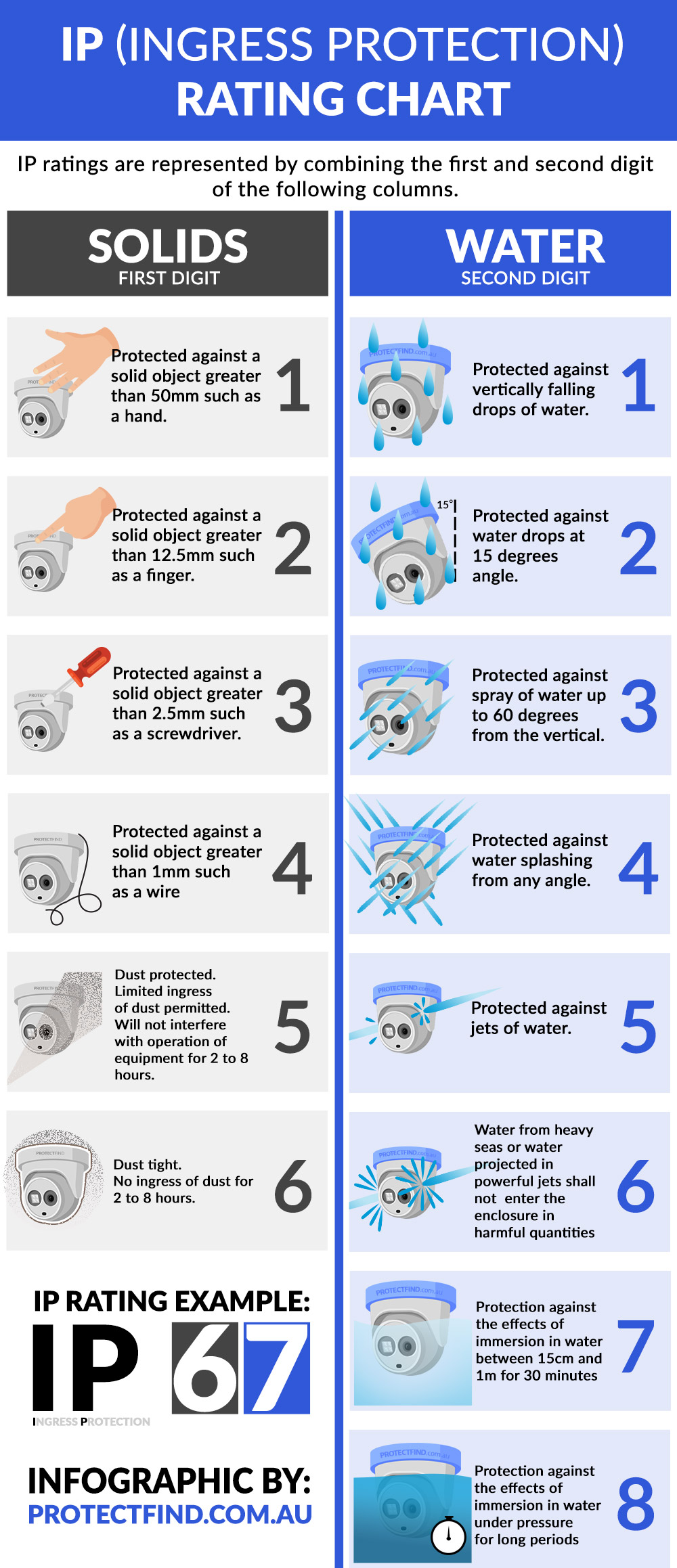
A security cameras IP rating is represented by combining two digits (IP##). The first digit is its protection against solids, and the second number is its protection against water.
The higher the number, the more protection it has.
Security Cameras Dust Tolerance
SOLID IP RATING | OBJECT SIZE PROTECTED FROM | |
|---|---|---|
1 | 50mm object, like a hand | |
2 | 12.5mm object, like a finger | |
3 | 2.5mm object, like a screwdriver | |
4 | 1mm object, like a piece of wire | |
5 | Dust protection won’t interfere with the operation | |
6 | Dust-tight. No dust will get in | |
Security Cameras Water / Liquid Tolerance
LIQUID IP RATING | OBJECT SIZE PROTECTED FROM | |
|---|---|---|
0 | No water resistance (use only indoors) | |
1 | Small drops of water falling vertically like light rain | |
2 | Small drops of water falling at 15-degrees, like wind pushing rain diagonally | |
3 | Spray of water up to 60 degrees | |
4 | Water splashing from any angle | |
5 | Light water jets, like a garden hose | |
6 | Strong water jet, like a non-damaging pressure washer | |
7 | Underwater at 15cm – 1m, for up to 30 minutes | |
8 | Underwater beyond 3ft for long periods | |
Some IP Rating Examples
What does IP66 mean? IP66 means the camera is dust-tight and is protected against strong jets of water (for example, someone with a non-surface damaging pressure washer)
What does IP67 mean? IP67 means the camera is dust-tight and protected against immersion in water up to 1 metre for 30 minutes.
What does IP68 mean? IP68 means that the camera is dust-tight and protected against immersion effects in water under pressure (so a little deeper) for long periods.
2
Waterproof vs Weatherproof Security Cameras
Understanding what is waterproof and weatherproof is one of the main reasons people look at IP ratings. One of the reasons IP ratings exist is to help define vague marketing claims.
Waterproof is generally considered IP65, IP66, IP67, and IP68. With IPX7 and IPX8 referring to total immersion underwater.
Weatherproof is generally considered IPX2 or higher. IPX2 protects against water drops coming down at a 15-degree angle. Rain tends to fall relatively vertical even under strong winds and at low pressure.
3
What is an IPX Rating?
In some cases, you may see a camera with a rating like IPX6 or IP5X. This means that one of the protection ratings has not been tested for or just not provided. The X replaces the unknown number.
4
Our Handy IP Rating Chart
5
What is the IK Rating of a Camera?
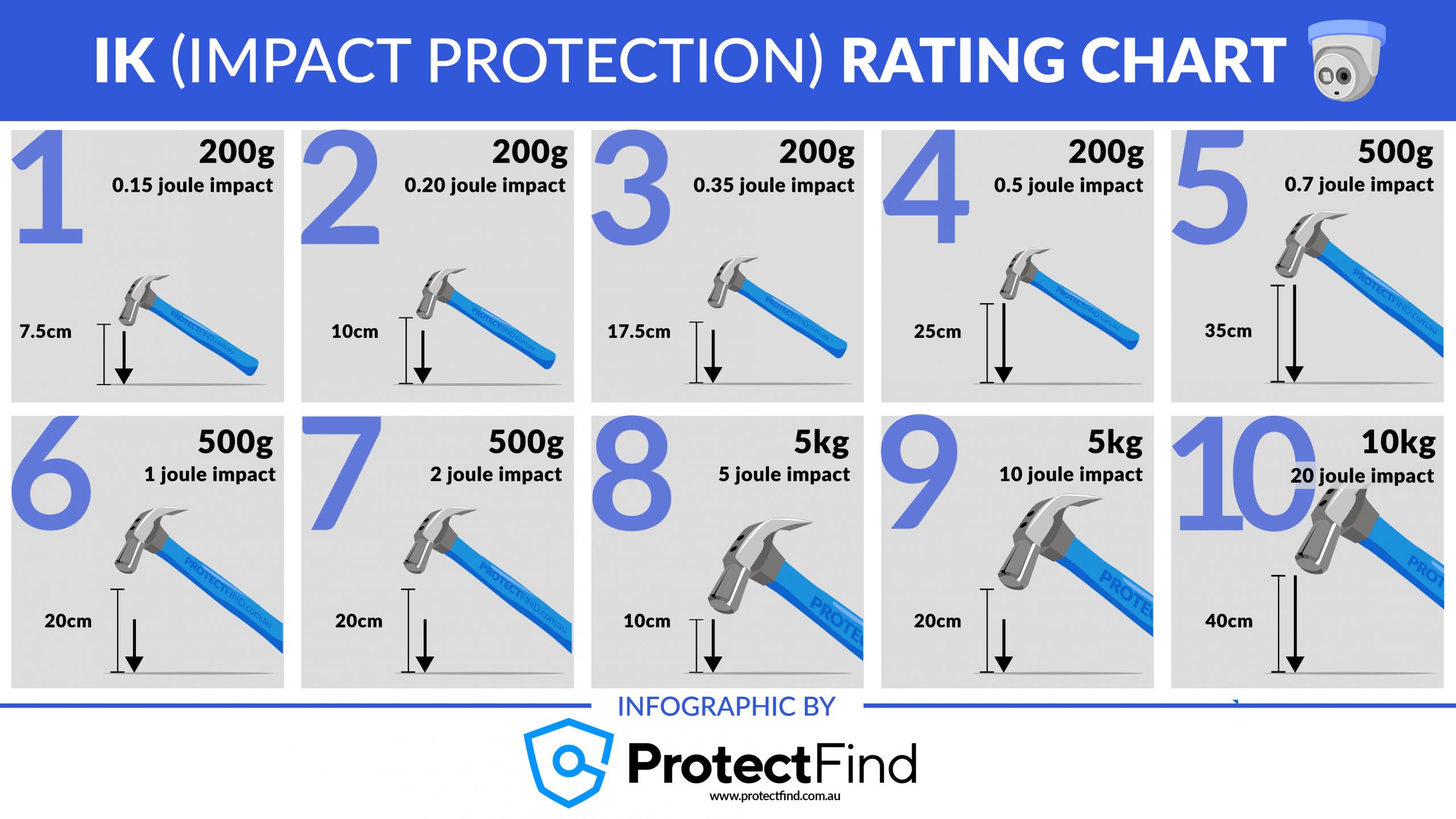
The IK rating determines how much of a strike a Dome security camera can survive. The I stands for Impact, and the K stands for Kinetic. While it is still about “Impact Protection”, they use “Kinetic” to differentiate it from the Ingress Protection (IP##) standard mentioned above.
The highest IK rating available is IK10 and is often marketed as vandal-resistant or even vandal-proof. This isn’t quite accurate because IK10 can only survive a 20-joule impact. To put that in perspective, a strike with a baseball bat is anywhere from 200 to 400 joules.
There is also a tradeoff. Vandal-resistant cameras use IK10 glass, whereas bullet or turret cameras use anti-reflection glass. Anti-reflection glass is not available on the curved protective glass dome, which results in a worse image at night.
“Vandal-resistant” cameras are only recommended in places where there is a high likelihood of vandalism, and you cant mount the camera high enough to be out of reach—for example, a school hallway.
IK RATING | PROTECTED AGAINST | |
|---|---|---|
0 | No protection | |
1 | 200g weight, dropped from 7.5cm above it (0.15 joules) | |
2 | 200g weight, dropped from 10cm above it (0.20 joules) | |
3 | 200g weight, dropped from 17.5cm above it (0.35 joules) | |
4 | 200g weight, dropped from 25cm above it (0.5 joules) | |
5 | 500g weight, dropped from 35cm above it (0.7 joules) | |
6 | 500g weight, dropped from 20cm above it (1 joule) | |
7 | 500g weight, dropped from 20cm above it (2 joules) | |
8 | 5kg weight, dropped from 10cm above it (5 joules) | |
9 | 5kg weight, dropped from 20cm above it (10 joules) | |
10 | 10kg weight, dropped from 40cm above it (20 joules) | |
6
Frequently Asked Questions
What IP rating is waterproof?
The IP ratings that are widely accepted as "waterproof" are IP65, IP66, and IP67. These protect against low-pressure water jets, but only IP67 and IP68 would survive being immersed in water for a short amount of time.
What is the best IP rating for outdoor security cameras?
IP65 rating or higher is enough to survive what the weather can throw at it. However, IP65 isn't designed to survive strong hose-directed water.
7
What’s Next?
Hopefully, that clears up some of your questions about a security camera's IP and IK ratings. If you still have any additional questions, you can email us here, and I'll be happy to answer them.
Or you can join our Facebook group and I'll be happy to answer any questions there.